
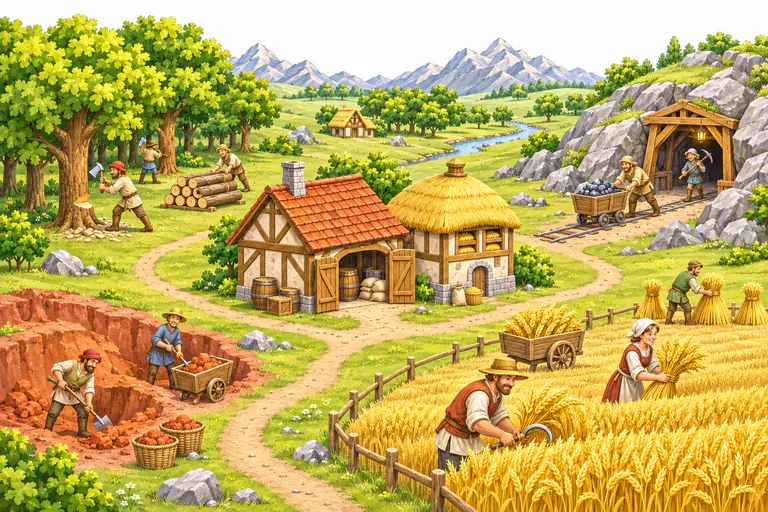
- Everything is paid in four resources that your fields produce every hour.
- Raise the fields evenly, and grow your stores with your production.
- Watch your net crop: if it goes negative, the granary empties and then falls below zero.
The four fields
- Woodcutter: produces wood.
- Clay Pit: produces clay.
- Iron Mine: produces iron.
- Cropland: produces the crop your people and soldiers eat.
Every level you add raises a field's output. Early on, raise all four evenly, because every building needs all of them. Fields keep producing while you are away.
The fields of an ordinary village go up to level 10; only the capital's go up to level 20. That is why the capital usually becomes your account's biggest crop producer.
Crop
Your village's people and soldiers eat crop every hour, and what is left over is your net crop. If it goes negative, the Granary empties and then falls below zero: your soldiers don't die, but every bit of crop your fields make pays back that debt, and nothing that costs crop can be built or trained until it is paid. The resource bar warns you before the crop runs out. You can clear the debt with gold on the Plus page, one gold for every 250,000 crop you owe. Check this number before you train a big army.
Storage and protection
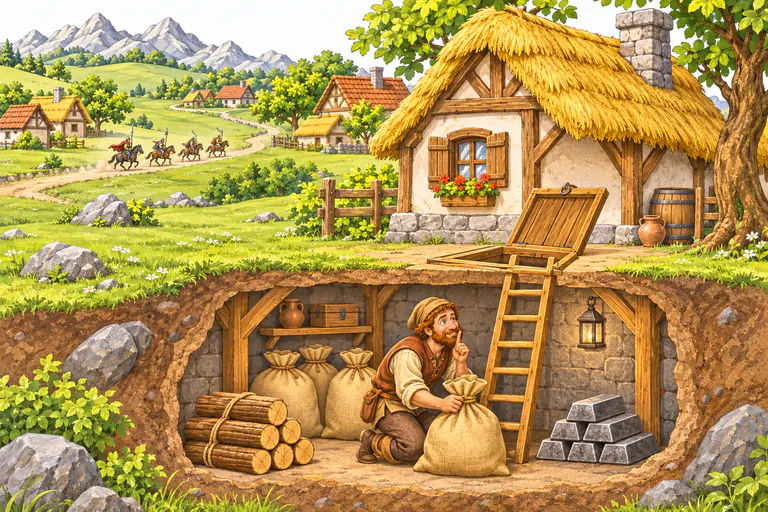
- Warehouse: stores wood, clay and iron.
- Granary: stores crop.
- Cranny: hides part of your resources from raiders, from 100 at level 1 to 1000 at level 10 of each resource. A Gaul Cranny hides twice as much, and raiding Teutons respect only 80% of it.
Whatever goes over your storage is lost, so upgrade it as your production grows. Once a Warehouse or Granary reaches level 20 you can build another beside it.
How to raise your production
- Production buildings (Sawmill, Brickyard, Iron Foundry, Grain Mill, Bakery): each raises its resource by a percentage, once one of its fields reaches a set level.
- Oases: your hero takes them, and your village gets 25% or 50% more. Details in the chapter on the hero and oases.
- Gold: 25% more of any resource for a while. Details in the chapter on gold.
- The Marketplace: trade what you have too much of for what you lack. Details in the chapter on the market.